

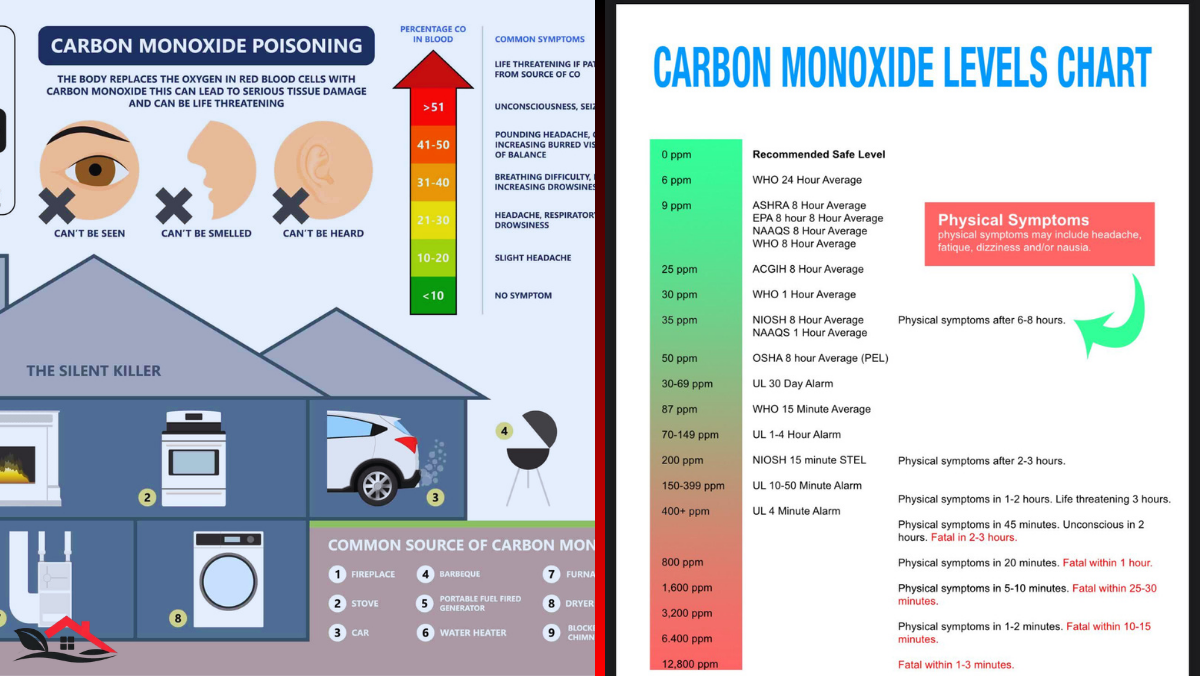
Understanding does carbon monoxide rise or fall is essential for home safety, yet it remains one of the most misunderstood topics. Many people assume gases behave predictably—some rise, others sink—but carbon monoxide (CO) does not follow such simple rules.
If you rely on incorrect assumptions, you could unknowingly place yourself at risk. This guide provides a clear, science-based explanation of how carbon monoxide behaves, why it spreads the way it does, and what that means for your safety.
Does Carbon Monoxide Rise or Fall?
The direct answer to does carbon monoxide rise or fall is:
Carbon monoxide does not consistently rise or fall—it mixes evenly with the surrounding air.
Although carbon monoxide is slightly lighter than air, the difference is so minimal that it does not create noticeable upward movement. Instead, CO disperses quickly throughout a space, making it dangerous at all levels.
This is why safety recommendations focus on overall coverage rather than placing detectors at a specific height.
Why Carbon Monoxide Doesn’t Simply Rise or Fall
To fully understand does carbon monoxide rise or fall, it’s important to explore the science behind gas behavior.
Density and Molecular Weight
Carbon monoxide has a molecular weight of approximately 28, while air averages around 29. This makes CO slightly lighter than air—but only by a tiny margin.
In practical terms, this difference is negligible. Unlike helium, which rises rapidly, or propane, which tends to settle, carbon monoxide behaves more like air itself.
Real-World Conditions
In a perfectly still environment, gases might separate based on density. But in real homes, conditions are never static. Air is constantly moving due to:
- Heating and cooling systems
- Open doors and windows
- People moving around
- Natural convection currents
These factors cause carbon monoxide to spread quickly and evenly, overriding any minor differences in density.
The Role of Temperature in Carbon Monoxide Movement
Temperature plays a significant role in how carbon monoxide behaves, especially right after it is produced.
Warm Carbon Monoxide Initially Rises
Carbon monoxide is typically produced by combustion processes, such as:
- Gas furnaces
- Stoves and ovens
- Fireplaces
- Vehicle engines
When first released, the gas is warm. Warm air is less dense, so it tends to rise. At this stage, carbon monoxide may move upward briefly.
Cooling Leads to Even Distribution
As the gas cools, it loses any upward momentum. Its density becomes nearly identical to the surrounding air, causing it to spread uniformly throughout the space.
What This Means in Practice
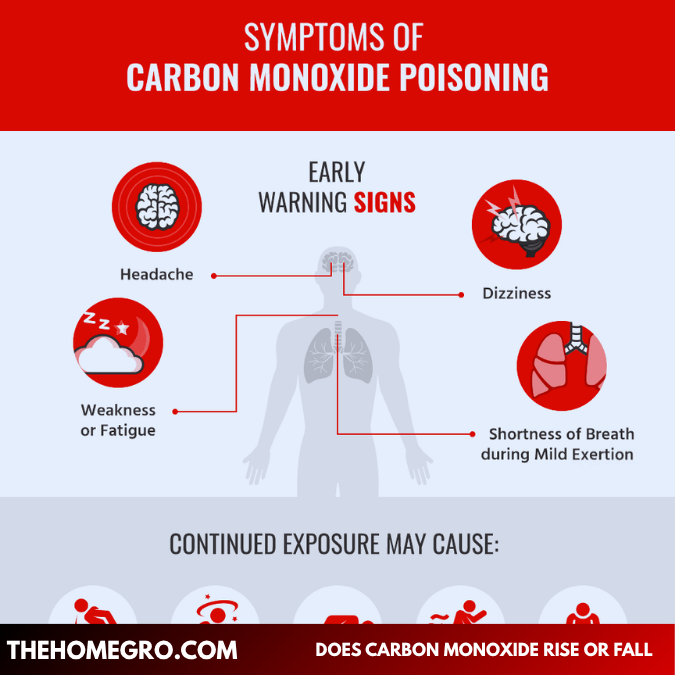
If you’re wondering does carbon monoxide rise or fall, the temperature-based answer is:
- It may rise for a short time when hot
- It quickly disperses as it cools
How Airflow Affects Carbon Monoxide Distribution
Airflow is one of the most important factors influencing how carbon monoxide moves.
Air Circulation Spreads CO Rapidly
In any occupied space, air is constantly circulating. Even subtle movements—like walking across a room or a fan running—can distribute gases.
Because carbon monoxide is so similar to air in density, it is easily carried along with these currents.
Diffusion Ensures Even Mixing
Carbon monoxide also spreads through diffusion, a natural process where gases move from areas of high concentration to areas of lower concentration.
This means that over time, CO will fill an entire room evenly, regardless of where it started.
Does Carbon Monoxide Stay Near the Ceiling or Floor?
A common misconception is that carbon monoxide collects at a certain level.
It Does Not Form Layers
Carbon monoxide does not:
- Stay near the ceiling
- Sink to the floor
- Remain confined to one area
Instead, it becomes evenly distributed throughout the air in a room.
Temporary Concentration Near the Source
Immediately after being released, CO levels may be higher near the source—such as a malfunctioning appliance. However, this imbalance disappears quickly as the gas spreads.
Real-Life Scenario: How Carbon Monoxide Spreads
To better understand does carbon monoxide rise or fall, consider this example:
A faulty gas heater in a living room begins emitting carbon monoxide.
- The gas is released warm and rises slightly
- It begins to cool within seconds
- Air currents carry it throughout the room
- Within minutes, it is evenly distributed
At this point, everyone in the room is exposed, regardless of their position.
Why This Matters for Home Safety
Understanding does carbon monoxide rise or fall has real-world implications for protecting yourself and your family.
No “Safe Zone” in a Room
Because carbon monoxide spreads evenly:
- Sitting low to the ground does not reduce exposure
- Standing or sleeping at a higher level offers no protection
- Everyone in the space is at equal risk
Detector Placement Matters
Since CO doesn’t stay in one place, detectors should be installed:
- On every level of your home
- Near sleeping areas
- In accordance with manufacturer instructions
The goal is full coverage, not targeting a specific height.
Common Myths About Carbon Monoxide
Myth 1: Carbon Monoxide Always Rises
While it may rise briefly when hot, it does not stay near the ceiling and quickly spreads.
Myth 2: Carbon Monoxide Sinks Like Heavy Gas
CO is not heavy enough to sink significantly. It behaves almost identically to air.
Myth 3: You Can Avoid CO by Staying Low
This is dangerous misinformation. Carbon monoxide distributes evenly, so no level is safer.
Frequently Asked Questions About Does Carbon Monoxide Rise or Fall
Does carbon monoxide rise or fall in a house?
Carbon monoxide does neither consistently. It mixes evenly with air and can be found throughout a home.
Is carbon monoxide lighter than air?
Yes, but only slightly. This small difference does not significantly affect its movement in real environments.
Where is carbon monoxide most dangerous?
It is dangerous everywhere in a space because it spreads evenly. Initial concentrations may be higher near the source, but this changes quickly.
Should carbon monoxide detectors be placed high or low?
They can be installed on ceilings or walls. Placement should follow manufacturer guidelines rather than assumptions about gas behavior.
Does carbon monoxide stay near the ceiling?
No. It may rise briefly when warm, but it does not remain there and will spread throughout the room.
Can carbon monoxide sink to the floor?
Not in any meaningful way. Its density is too similar to air for it to settle at the bottom.
Practical Safety Tips Based on CO Behavior
Knowing the answer to does carbon monoxide rise or fall helps guide effective safety practices:
- Install carbon monoxide detectors on every floor
- Test alarms regularly to ensure they function properly
- Keep fuel-burning appliances well-maintained
- Ensure proper ventilation in your home
- Never run vehicles or generators in enclosed spaces
These measures are far more important than trying to predict where CO might accumulate.
Conclusion: Does Carbon Monoxide Rise or Fall?
So, does carbon monoxide rise or fall?
The most accurate and reliable answer is:
Carbon monoxide neither rises nor falls in a predictable way—it spreads evenly throughout the air.
While it may rise briefly when warm, it quickly cools and mixes with surrounding air due to airflow and diffusion. This makes it a serious hazard at any height within a space.
Understanding this behavior is crucial for proper safety planning. Instead of focusing on whether carbon monoxide rises or falls, prioritize full coverage with detectors and regular maintenance of appliances.
When it comes to carbon monoxide, awareness and preparation are the keys to staying safe.
You May Also Read: The Home Gro
