

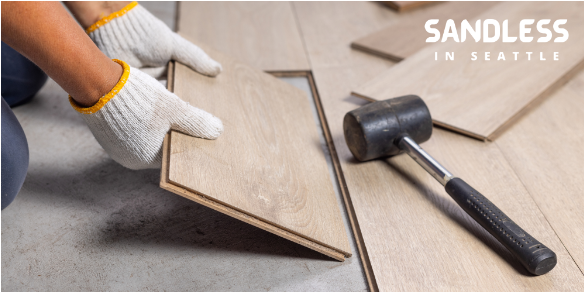
Installing solid or engineered hardwood adds value, insulation, and lasting beauty to a home, but its durability depends on proper execution.
Working with qualified local specialists for a hardwood flooring installation near me ensures your floors are installed correctly through proper subfloor prep, moisture testing, wood acclimation, and precise fastening.
Choosing experienced professionals for a hardwood flooring installation near me protects your investment and ensures long-lasting results.
The Foundation of Excellence: Subfloor Preparation and Assessment
A successful installation depends on the condition of the underlying substrate. Premium hardwood planks cannot compensate for an uneven, damaged, or moisture-laden subfloor.
Professional installers conduct thorough assessments using calibrated testing equipment before laying a single board.
Key subfloor evaluation factors include:
- Subfloor Leveling: Substrates must meet strict industry tolerances, typically within 3/16 inch over a 10-foot radius. Technicians apply self-leveling compounds to low spots or grind down high areas on concrete slabs to create an exceptionally flat surface.
- Moisture Content Testing: Using pinless or pin-type moisture meters, installers measure the moisture levels of both the subfloor and the wood planks. A difference exceeding 2% to 4% (depending on plank width) can lead to post-installation cupping, crowning, or structural gapping.
- Structural Integrity: Plywood or OSB subfloors are inspected for squeaks, delamination, and subfloor movement. Fastening loose panels directly to floor joists prevents persistent structural noise.
Material Selection: Solid vs. Engineered Hardwood
Understanding the structural differences between solid timber and engineered wood products allows property owners to select the ideal option for specific architectural zones.
| Feature | Solid Hardwood Flooring | Engineered Hardwood Flooring |
| Composition | 100% solid natural timber throughout the plank | Multi-layer plywood core topped with a real hardwood veneer |
| Dimensional Stability | Expands/contracts significantly with humidity | Superior resistance to thermal and moisture fluctuations |
| Installation Grade | Suitable for ground-level and above-grade installation | Suitable for all levels, including below-grade basements |
| Attachment Methods | Nail-down or staple-down over wooden subfloors | Floating, glue-down, or nail-down applications |
| Refinishing Potential | Can be sanded and refinished multiple times | Can be refinished 1–3 times, depending on wear-layer thickness |
Solid wood delivers authentic craftsmanship and decades of refinishing potential, making it ideal for primary living areas.
Conversely, engineered hardwood offers dimensional stability that performs exceptionally well over radiant heating systems, over concrete foundations, or in moisture-prone ground-level settings.
Essential Site Conditioning and Material Acclimation
Wood is an organic, hygroscopic material that naturally absorbs and releases moisture relative to its surrounding environment. Neglecting the acclimation process is one of the leading causes of premature floor failure.
Professional installation teams deliver materials to the job site well ahead of the scheduled work date. The wood planks are unboxed or cross-stacked in the installation zone with climate control systems fully operational.
This step allows the timber to reach an equilibrium moisture content (EMC) matching the home’s normal living conditions.
Skipping acclimation often results in severe expansion during humid seasons, leading to edge buckling, or excessive shrinkage in dry conditions, causing wide gaps between boards.
Fastening Techniques and Precision Laying Methods
The selection of the fastening method depends on the substrate type, the chosen wood species, and the width of the planks:
- Nail-Down or Staple-Down: Used primarily for solid wood planks over wood subfloors. Installers drive pneumatic fasteners through the tongue of each board at precise intervals to secure the layout while concealing the hardware.
- Glue-Down Method: Essential when installing wood directly onto concrete slabs or when utilizing wide-plank engineered timber. Specialized elastomeric adhesives provide a secure bond while offering built-in sound dampening and moisture barrier protection.
- Floating Floor Installation: Frequently selected for engineered wood, this method involves edge-gluing planks together or locking them into place over an acoustical underlayment pad without bonding the floor directly to the subfloor.
Key Criteria for Selecting Qualified Local Contractors
Locating a dependable contractor for a hardwood flooring installation near me requires evaluating verifiable credentials rather than simply accepting the lowest bid.
A properly executed floor requires technical expertise, specialized equipment, and adherence to trade standards.
- Industry Certifications: Look for installers affiliated with recognized trade associations, such as the National Wood Flooring Association (NWFA), which verifies compliance with standardized installation methodologies.
- Comprehensive Estimates: A detailed written estimate should clearly break down material costs, subfloor remediation charges, labor fees, baseboard trim work, and site cleanup protocols.
- Dust Containment Systems: Modern installation teams utilize advanced HEPA-filtered vacuum attachments on cutting and sanding machinery to maintain indoor air quality and protect the surrounding home interior.
Frequently Asked Questions
What is the required acclimation time for hardwood flooring?
Usually 3 to 7 days, though exact timing depends on room humidity and wood species. Installers must always verify moisture levels with a meter before starting.
Is solid hardwood suitable for direct-glue installation over concrete subfloors?
No. Solid wood absorbs ground moisture, requiring a subfloor and moisture barrier first. For direct application over concrete, engineered hardwood is the industry-standard choice.
When can furniture be moved back onto new floors?
- Pre-finished floors: Walk on them right away; move heavy furniture after 24 hours.
- Site-finished floors: Wait 24–48 hours for foot traffic and 72 hours before moving furniture back.
