


Vaulted ceiling lighting plays a critical role in transforming a room from simply spacious to truly breathtaking. While vaulted ceilings naturally create a sense of openness and architectural drama, they can also feel cold, dim, or unbalanced without the right lighting strategy. This is why thoughtful planning is essential—lighting must not only fill the vertical space but also bring warmth, functionality, and visual harmony to the entire room.
This comprehensive guide explores vaulted ceiling lighting in depth, covering design principles, fixture types, placement strategies, and expert insights to help you achieve a perfectly illuminated space.
Understanding Vaulted Ceiling Lighting
Vaulted ceiling lighting refers to lighting solutions specifically designed for ceilings that slope upward or rise to a peak. Unlike standard flat ceilings, vaulted ceilings introduce height, angles, and depth that significantly affect how light behaves in a room.
Because light disperses differently in these spaces, traditional lighting approaches often fall short. A single ceiling fixture, for example, may leave the lower half of the room underlit while creating glare near the ceiling peak. Proper vaulted ceiling lighting addresses these challenges by distributing light evenly across both vertical and horizontal planes.
Why Vaulted Ceiling Lighting Matters
Lighting is not just about visibility—it defines how a space feels and functions. In rooms with vaulted ceilings, lighting becomes even more important for several reasons.
First, it enhances architectural features. Vaulted ceilings are often a focal point, and the right lighting can highlight beams, textures, and angles.
Second, it improves usability. Without proper lighting, large spaces can feel dim and impractical, especially in areas like kitchens or living rooms.
Finally, it creates balance. A well-lit room feels cohesive, while poor lighting can make even a beautifully designed space feel incomplete.
Challenges of Lighting Vaulted Ceilings
Uneven Illumination
One of the most common issues with vaulted ceiling lighting is uneven light distribution. Light tends to concentrate near the source, leaving lower areas darker.
Excessive Height
High ceilings require stronger or strategically placed lighting to ensure sufficient brightness reaches the floor level.
Installation Complexity
Sloped ceilings make installation more difficult. Fixtures must often be adjusted or customized to align properly.
Maintenance Difficulties
Replacing bulbs or cleaning fixtures can be challenging due to height, making durability and longevity important considerations.
Core Principles of Effective Vaulted Ceiling Lighting
Layered Lighting Approach
The foundation of successful vaulted ceiling lighting is layering. Instead of relying on a single light source, combine multiple types of lighting to achieve balance.
- Ambient lighting provides overall illumination
- Task lighting focuses on specific activities
- Accent lighting highlights architectural details
This layered approach ensures both functionality and visual depth.
Proportion and Scale
Lighting fixtures must match the scale of the room. In large vaulted spaces, small fixtures can look insignificant and fail to provide adequate light. Conversely, oversized fixtures can overwhelm the design.
Choosing the right size ensures both visual harmony and effective illumination.
Strategic Placement
Placement is just as important as fixture selection. Lights should be positioned to minimize shadows and evenly distribute brightness throughout the space.
Best Lighting Options for Vaulted Ceilings
Chandeliers
Chandeliers are a classic choice for vaulted ceiling lighting. They fill vertical space and act as a striking focal point.
They are particularly effective in:
- Living rooms
- Entryways
- Dining areas
A well-positioned chandelier draws the eye upward while providing broad illumination.
Pendant Lighting
Pendant lights are versatile and ideal for task-oriented areas. They work well over kitchen islands, dining tables, or seating areas.
Their adjustable height makes them especially suitable for vaulted ceilings, allowing precise control over light placement.
Recessed Lighting
Recessed lighting offers a clean and modern solution. Installed directly into the ceiling, these fixtures provide even ambient lighting without visual clutter.
They are particularly effective when spaced evenly across the ceiling to eliminate dark spots.
Track Lighting
Track lighting provides flexibility and directional control. It allows you to adjust individual lights to focus on specific areas or features.
This makes it a great option for multi-functional spaces or rooms with unique layouts.
LED Strip Lighting
LED strip lighting is ideal for creating soft, indirect illumination. It can be installed along beams, edges, or coves to enhance architectural details.
This type of lighting adds depth and ambiance without overwhelming the space.
Wall Lighting and Floor Lamps
Supplementary lighting at lower levels helps balance the brightness in a room with a vaulted ceiling.
Wall sconces and floor lamps bring light closer to eye level, making the space feel more comfortable and inviting.
Room-Specific Vaulted Ceiling Lighting Ideas
Living Room
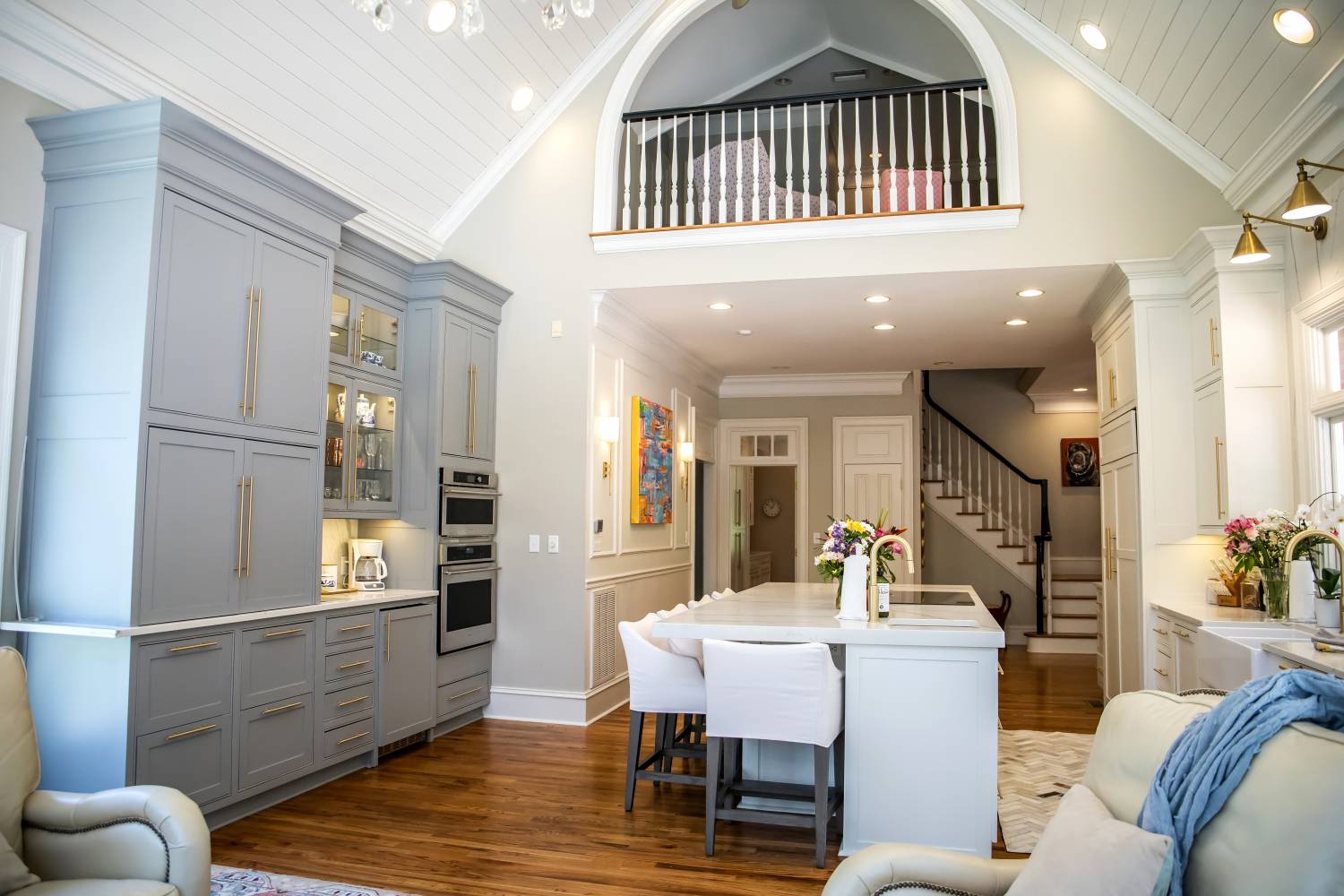
In living rooms, vaulted ceiling lighting should create a balance between openness and comfort.
A combination of a central chandelier, recessed lighting, and floor lamps works well. This layered approach prevents the space from feeling too vast or empty.
Kitchen
Kitchens require functional lighting that supports daily tasks.
Effective solutions include:
- Pendant lights over islands
- Recessed ceiling lighting
- Under-cabinet lighting
This combination ensures all work areas are properly illuminated.
Bedroom
Bedrooms benefit from softer, more relaxing lighting.
Warm recessed lights, bedside lamps, and subtle accent lighting create a cozy atmosphere while maintaining adequate brightness.
Entryway
Entryways with vaulted ceilings offer an opportunity to make a bold statement.
Large chandeliers or multi-tier pendant lights can emphasize height and create a dramatic first impression.
Choosing the Right Bulbs and Brightness
Light quality is just as important as fixture design. Selecting the right bulbs ensures comfort and efficiency.
Warm white light (2700K–3000K) creates a cozy atmosphere, while neutral white (3500K–4000K) is better for task-oriented spaces.
Brightness should be sufficient to fill the vertical space without causing glare. Using multiple lower-intensity lights often works better than relying on a single high-intensity source.
Importance of Dimmers in Vaulted Ceiling Lighting
Dimmers are essential for controlling light intensity in large spaces. They allow you to adjust lighting based on time of day, mood, or activity.
For example, bright lighting may be needed during the day, while softer lighting is preferable in the evening.
Dimmers also improve energy efficiency and extend bulb lifespan.
Common Mistakes to Avoid
Relying on a Single Fixture
One of the biggest mistakes is using only one light source. This often results in uneven lighting and poor functionality.
Ignoring Ceiling Angles
Failing to account for the slope of the ceiling can lead to poorly aligned fixtures and ineffective lighting.
Choosing Incorrect Fixture Size
Improperly sized fixtures disrupt both aesthetics and performance.
Overlooking Layered Lighting
Without layering, the space may feel flat or incomplete.
Neglecting Maintenance Planning
Choosing fixtures that are difficult to access can create long-term inconvenience.
Advanced Design Techniques
Highlighting Architectural Features
Use lighting to draw attention to beams, textures, or unique ceiling shapes. Accent lighting can add depth and character.
Combining Direct and Indirect Lighting
Direct lighting provides functionality, while indirect lighting softens the space and reduces glare.
This combination creates a balanced and visually appealing environment.
Creating Visual Focal Points
In large rooms, a statement fixture can anchor the design and guide the eye.
Incorporating Smart Lighting
Smart lighting systems allow remote control, scheduling, and customization. This adds convenience and enhances the overall experience.
Energy Efficiency Considerations
Modern vaulted ceiling lighting often relies on LED technology due to its efficiency and longevity.
LED lights:
- Consume less energy
- Last significantly longer
- Produce less heat
This makes them ideal for hard-to-reach vaulted ceilings.
Conclusion
Vaulted ceiling lighting is a crucial element in designing spaces that are both beautiful and functional. The height and structure of vaulted ceilings present unique challenges, but they also offer incredible opportunities for creativity and impact.
By using a layered lighting approach, selecting appropriately scaled fixtures, and carefully planning placement, you can achieve a well-balanced and inviting environment.
Ultimately, the goal of vaulted ceiling lighting is not just to illuminate a room, but to enhance its architecture, improve its usability, and create a space that feels cohesive and comfortable. When done right, it transforms a room into something truly exceptional.
